
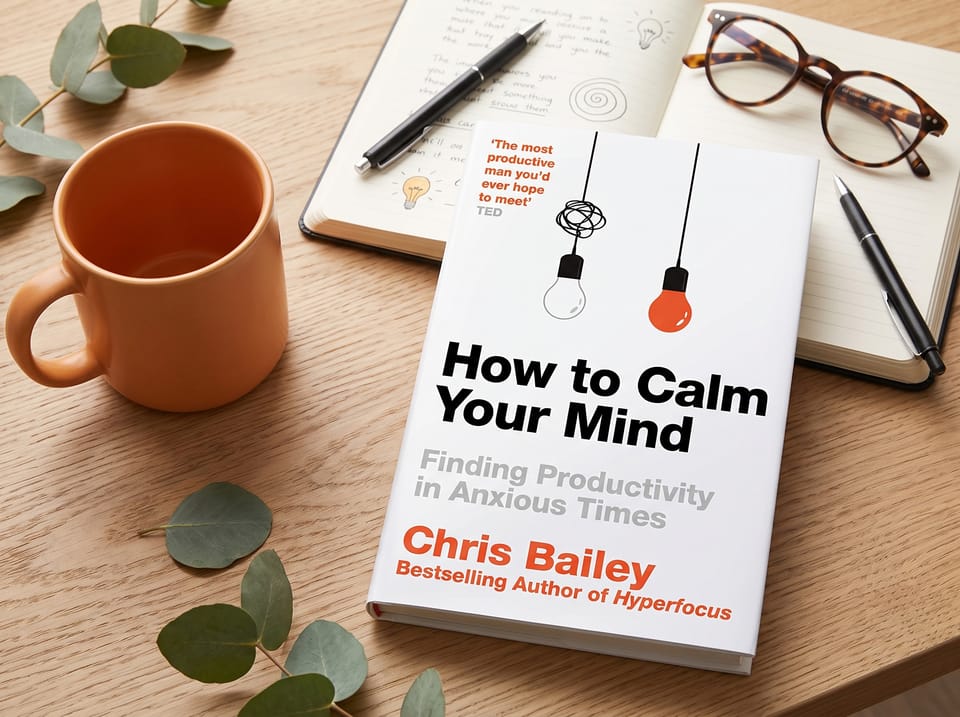
I picked up Chris Bailey’s How to Calm Your Mind the way I pick up most books lately: not because I was in crisis, just curious. No burnout, no dramatic life event pushing me toward the self-help aisle. I just wanted to know what a professional productivity guy had to say about the exact opposite of productivity.
That’s the joke at the center of the book, and it’s a good one. Bailey spent his career showing people how to squeeze more output from their days, until a panic attack on stage made him realize he had never once learned how to feel calm while doing it. So he wrote this instead—a book about slowing down, from a guy whose entire résumé is about speeding up.
Nothing new. Maybe that's the point.
Most of the book didn't surprise me. Less phone time, less doomscrolling, more real-world experiences—if you’ve read anything in this genre, you’ve heard this phrases before. In the middle stretch, the book openly repeats itself: dopamine bad, presence good, here is another anecdote about trying something analog. I caught myself skimming a few chapters, waiting for the next genuinely novel idea to show up.
The more I sat with that irritation, though, the less it bothered me. A book like this isn't trying to win a novelty contest; it’s trying to get implemented. And something is only implementable if it’s easy to grasp—which usually means it can't be dense, clever, or shocking on every single page. If the advice had been intellectually complex, I probably would have admired it and done nothing. The plainness is what allowed it to actually land. The point was never to say something brand-new. It was to say something usable, enough times that it finally stuck.
What actually stuck: the digital-to-analog swap
The section that really got under my skin was Bailey’s core experiment: swapping digital inputs for analog ones. Unsubscribing from digital news and buying a printed paper. Turning off notifications and batching replies into dedicated windows. Not gentle moderation, but a deliberate substitution. His reasoning comes down to stimulation:
I didn't go the full distance, and I don't plan to. I’m not muting messages, phone calls, or banking alerts. The "what if it’s family" or "what if my card is compromised" worries are real enough that I won't risk missing them.
Instead of Bailey’s total blackout, I built my own version of the swap: I deleted the social apps from my phone without deleting the accounts. If I want to scroll on my phone, I have to open the app store, download the app, log in, browse, and delete it again immediately after. That small mechanical friction does the work willpower never could. On my laptop, those sites are still just one browser tab away, but a laptop doesn't ride in my pocket or vibrate against my thigh.
I’m still mid-experiment, but something did shift: I’ve started catching my own thumb reaching for empty screen space during dead moments. Waiting for a page to load. Standing in line. That tiny, automatic twitch was completely invisible to me before. Now I see it happen in real time.
Why I'm even bothering with this
Here's the honest reason I started this experiment, and it has less to do with the book and more to do with my commute.
I take public transport most days, and I've started noticing something that genuinely unsettles me: people walking while staring at their phones. Not a quick glance, but fully immersed, scrolling Threads or Twitter (yes, I still call it Twitter), watching TikTok, mid-video while their feet are moving. I used to assume they had something urgent like a Zoom meeting running late or a message from their boss. But when I actually looked, it was almost never that. It was just compulsive scrolling, for no particular reason, while walking down stairs, through crowded platforms, toward trains they were about to miss because they'd slowed to a crawl without noticing.
It's a small thing until you picture the mechanics of it: someone slow-walking down a staircase, phone up, then stopping abruptly at the bottom. Everyone behind them absorbs that stop, the way cars pile up when someone brake-checks on a packed freeway. One person's attention lapse becomes everyone else's problem.
I don't want to be that person. That's really what's underneath all of this — not screen time as a number I'm trying to optimize, but presence as something I don't want to keep losing without noticing. I've even stopped listening to music or podcasts once I'm on the train, which surprised me more than anything else the book pushed me toward. I used to think I needed noise to make wasted commute time feel productive. Now I just let it be quiet.
I still believe the urge to check the phone is inevitable, Bailey doesn't pretend otherwise either. But lately when I do open it mid-work and see that Instagram, Twitter, and Threads are already gone, I just... put it back down. I'll catch up on all of it at night. We need the dopamine, sure. I'm just trying not to get all of it from a screen.
So, worth reading?
Yes. I'm glad I read it. Not because every page was essential, but because one idea landed hard enough that I'm still running an experiment on myself weeks later. That's a decent return for a few hundred pages, even a slightly baggy few hundred pages.
If you want a tight, no-fluff argument, you might get impatient with it. But if you don’t mind some repetition in exchange for simple habits you can actually steal and use tomorrow, it's worth the time.
Apps deleted, accounts intact, thumb finally caught in the act. Still a work in progress — same as the author, apparently.